
General · AI & Growth
Is Your E-commerce Store Ready for AI Shopping?
7 min read · 16 Sept 2026
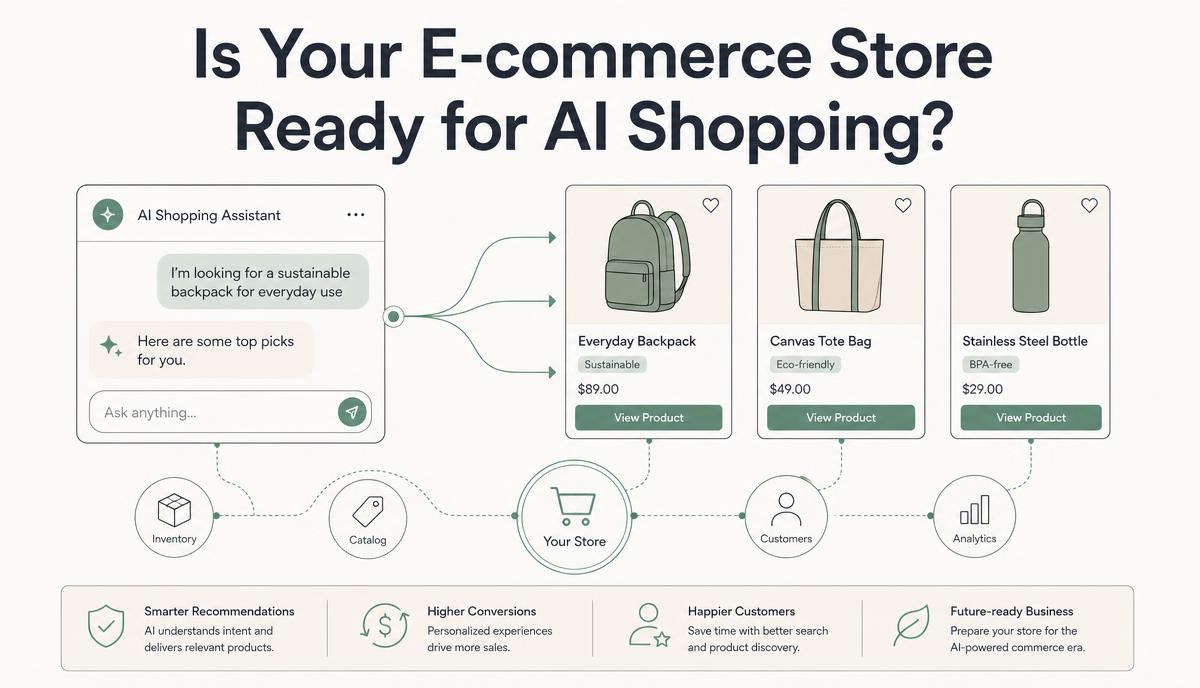
AI is changing how shoppers discover products. Here is how to prepare your product data, content and product pages for AI shopping and agentic commerce.
For years, buying something online followed a familiar path. A shopper searched Google, opened a few tabs, compared products, skimmed reviews, and eventually bought.
That path is widening. Shoppers can now use AI-powered search and assistants to discover products, compare options, ask detailed questions, narrow a shortlist, and get recommendations — often before they ever land on a product page.
Which raises a new question for every e-commerce brand: can AI systems understand your products well enough to recommend them?
AI shopping does not replace e-commerce fundamentals. It raises the stakes on them. Clean product data, useful content, solid SEO, well-built product pages, honest reviews, structured information and a smooth customer experience all matter more, not less.
What Is AI Shopping?
AI shopping is simply product discovery and research happening inside an AI-powered experience rather than only inside a list of blue links.
In practice that covers a few different things, and it helps to keep them separate:
- AI-assisted discovery — a shopper describes what they need in plain language and gets a shortlist.
- AI-powered recommendations — an assistant or on-site system suggests products based on context and stated needs.
- AI search — search results that summarise, compare and answer instead of only listing pages.
- Agentic purchasing — software completing steps of the purchase on the shopper''s behalf.
The first three are already part of everyday shopping behaviour. Fully agentic purchasing is still early and uneven across platforms. Preparing for it is sensible; assuming it has already arrived is not.
AI Is Changing Product Discovery
Traditional search is short and keyword-shaped:
best running shoes
AI-assisted discovery is longer, and far more specific:
I need running shoes for someone who runs 30 miles a week, has a wide foot, and wants something under $150.
That second query cannot be answered with a product title alone. To be a credible answer, a product needs to be understandable at the attribute level.
In practice, a discovery system needs to be able to work out:
- what the product actually is
- who it is for
- its key features and materials
- dimensions, sizing and variations
- price and availability
- realistic use cases
- what customers say about it
- how the brand positions itself
None of that is exotic. It is the information a good salesperson would give a customer — written down properly.
Your Product Data Matters More Than Ever
Product information needs to be accurate, consistent, structured, specific, current and easy to understand. That includes titles, descriptions, specifications, attributes, sizes, colours, materials, ingredients where relevant, compatibility, shipping, returns and availability.
Vague copy is the most common problem we see. It reads like marketing and communicates nothing.
Weak: "Premium everyday backpack designed for modern lifestyles."
Better: "Water-resistant 20L laptop backpack with a padded 16-inch laptop compartment, two exterior pockets and adjustable shoulder straps."
The second version is not less premium. It is simply useful. It gives a shopper a reason to choose, and gives a discovery system something concrete to match against.
SEO Is Still Important — But AEO Matters Too
SEO is not dead. Traditional search visibility and AI visibility increasingly draw on the same things: clear content, well-structured information and genuine authority on a topic.
Answer Engine Optimization (AEO) is a plain idea with an awkward name: making your content easy for answer engines and AI-powered search to understand and use when responding to a question.
The work overlaps heavily with good SEO:
- write for real search intent, not keyword counts
- answer the questions customers actually ask
- make product information explicit rather than implied
- use appropriate structured data
- link internally so context is clear
- build content that deserves to be cited
Your Product Page Needs to Answer Real Questions
A modern product page should answer questions before the shopper has to go looking for them:
- What is it, and who is it for?
- What problem does it solve?
- What are the dimensions and materials?
- How does it compare to the alternatives?
- What makes it different?
- How does sizing work?
- When will it arrive?
- What happens if it needs to go back?
Answering these improves the customer experience and, at the same time, makes the page far easier for machines to read. That is the same work done once. It is also where most conversion problems start — a point we cover in why your Shopify store gets traffic but doesn''t convert.
Reviews Are Part of the Product Story
Authentic customer reviews add context that no product description can: how something fits, how it holds up, who it suited, what surprised people.
Encourage detailed feedback, ask for photos, and prompt customers with specific questions rather than a star rating alone. Never create or incentivise fake reviews — it is dishonest, it breaches platform policy, and it degrades the exact signal you are trying to strengthen.
How Shopify Stores Can Prepare for AI Shopping
A practical starting checklist. Not every point carries the same weight for every catalogue, so sequence it around your own products:
- Improve product titles so they describe the product, not the mood.
- Write specific product descriptions with real detail.
- Complete product attributes and variant data.
- Keep pricing and inventory accurate.
- Improve product images and write meaningful alt text.
- Add FAQs that answer genuine pre-purchase questions.
- Strengthen internal linking between collections, products and content.
- Implement appropriate structured data.
- Build authentic reviews and social proof.
- Reduce friction across cart and checkout.
- Create supporting content — guides, comparisons, sizing help.
- Keep product information consistent across every channel you sell on.
What About Amazon, Faire and Wix?
Amazon
Clarity wins. Titles that describe the product accurately, bullet points that lead with the things buyers decide on, complete attributes, A+ Content that answers objections, strong images and genuine reviews all feed both Amazon''s own relevance and wider discovery. More on this in your Amazon listing is more than a product description.
Faire
Wholesale buyers evaluate differently. They need clear specifications, credible brand story, sensible assortment, wholesale pricing context and confidence that the line will sell through in their shop. See how to turn your Faire storefront into a stronger wholesale channel.
Wix
Get the foundations right: clean product page structure, sound technical SEO, complete product information, navigation that makes sense, and a conversion experience without dead ends. Related reading: your e-commerce website doesn''t need more features, it needs less friction.
AI Discovery and CRO Are Connected
Getting discovered is one step in a longer chain:
Discovery → Product Understanding → Product Experience → Conversion → Retention → Repeat Purchase
More visibility does not automatically produce more sales. If an AI assistant recommends your product and the page that follows is confusing, slow, thin on detail or short on trust, the shopper still leaves.
That is why we treat discovery and conversion as one system rather than two departments. Commerce, connected.
The AI-Commerce Readiness Checklist
- ☐ Are your product titles specific?
- ☐ Are your product descriptions genuinely useful?
- ☐ Are important product attributes complete?
- ☐ Can customers quickly understand who the product is for?
- ☐ Are pricing and availability accurate?
- ☐ Are your reviews authentic and informative?
- ☐ Can shoppers easily compare products?
- ☐ Are your FAQs answering real customer questions?
- ☐ Is your website technically accessible to search engines?
- ☐ Are you creating content that answers real search questions?
- ☐ Is your product information consistent across channels?
- ☐ Does the product page make it easy to buy?
Where Galaxy Team Fits
AI shopping readiness does not belong to one channel. It sits across e-commerce strategy, Shopify and Wix optimisation, Amazon and Faire marketplace work, SEO and AEO, product experience, CRO, content, analytics and retention.
That is the way we work. We don''t build disconnected marketing activities. We build connected commerce systems. You can see the commerce stack we work across, and how we work, on our homepage.
Getting Ready
AI shopping is not simply another traffic source. It is another way customers discover, evaluate and compare products — and it rewards the brands whose information is genuinely good.
Preparing for it takes more than AI-generated content. It takes accurate product information, strong customer experiences, useful content, and a commerce system where the parts work together.
Commerce is becoming more conversational, more connected and more intelligent. The question is whether your store is ready.
- AI shopping
- AI ecommerce
- AI product discovery
- agentic commerce
- ecommerce AI
- AI shopping optimization
- ecommerce SEO
- AEO
- AI search
- Shopify AI
- AI shopping agents
- product data optimization
- ecommerce CRO
- generative engine optimization