
General · Commerce
The First Purchase Is Not the Goal: How Ecommerce Brands Build Repeat Revenue in 2026
7 min read · 16 Sept 2026
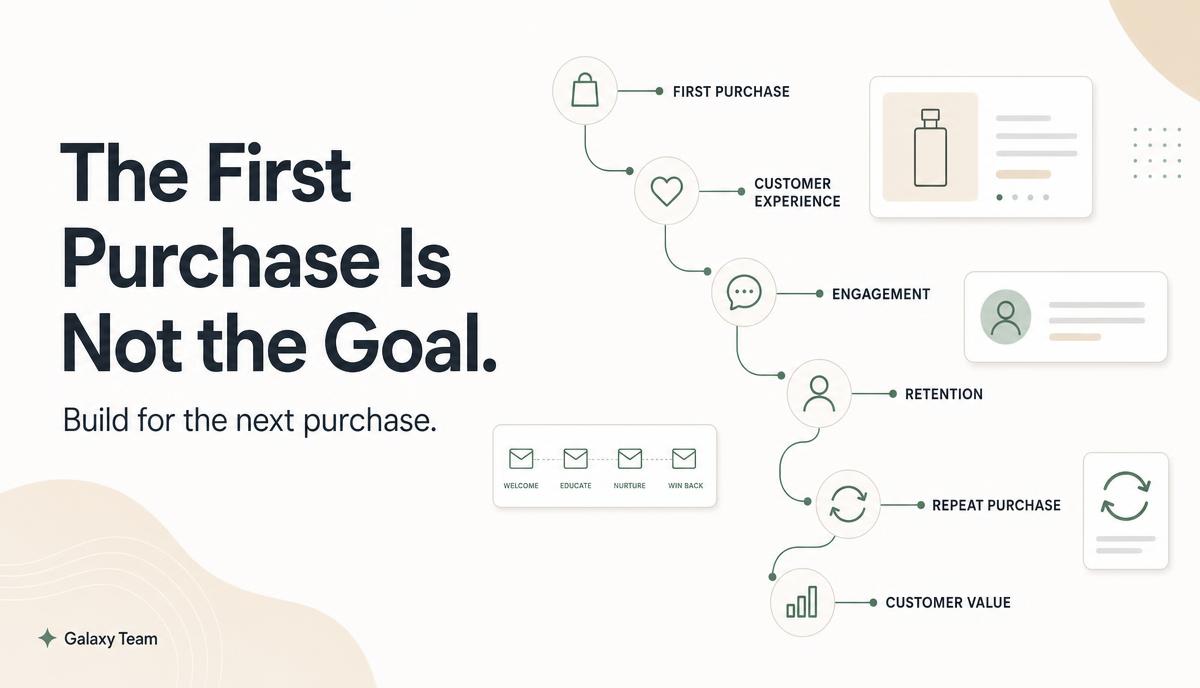
The first purchase is only the beginning. Learn how ecommerce brands can improve retention, create more repeat purchases, and build stronger long-term customer value.
Getting someone to buy from your store for the first time feels like the finish line. It isn''t. It is the beginning of the customer relationship.
For ecommerce brands, sustainable growth increasingly depends on what happens after the first order: whether customers return, what they buy next, how often they purchase, and whether the brand stays relevant between transactions.
As acquisition becomes more competitive, the question is no longer only "How do we get more customers?" It is "How do we create more value from the customers we are already winning?"
That is where retention becomes a growth strategy rather than just an email marketing activity.
What Is Ecommerce Retention?
Ecommerce retention is the work of encouraging customers who have already bought from your brand to come back and buy again.
- Email marketing
- SMS marketing
- Personalised product recommendations
- Post-purchase experiences
- Loyalty programmes
- Replenishment campaigns
- Cross-selling and upselling
- Customer service
- Product education
- Retargeting and community building
But retention is bigger than any single channel. A customer does not return simply because they received an email. They return because the overall experience gave them a reason to — the product, the trust, the service, a product they discovered next, or the sense that the brand understood what they needed.
Retention is the result of a connected customer experience.
Why the First Purchase Is Only the Beginning
Imagine two brands. Brand A pays to acquire a customer who buys once and never comes back. Brand B acquires a customer who goes on to buy several more times.
The second brand created far more value from the same relationship. That is why customer lifetime value and repeat purchase rate matter alongside revenue and conversion rate.
A store can grow traffic and first-time orders while still struggling to build a healthy returning customer base. A brand that improves retention can create additional revenue from customers it has already paid to acquire.
None of that makes acquisition unimportant. It means acquisition and retention should be considered together.
The Ecommerce Growth Equation Is Changing
For years growth was framed around one question: "How do we get more traffic?" Then it shifted to "How do we convert more traffic?" — a problem we covered in why your Shopify store gets traffic but doesn''t convert.
Now a third question sits alongside both: "How do we keep customers coming back?"
A stronger growth system looks more like:
Acquisition → Conversion → Customer Experience → Retention → Repeat Purchase
Each stage influences the next. If acquisition brings the wrong audience, conversion gets harder. If the product experience creates friction, retention suffers. If customers are never given a reason to return, the relationship ends after one order.
1. Start Retention Before the Customer Receives the Order
One of the biggest mistakes brands make is waiting until the product has arrived before thinking about retention. Retention starts the moment the order is placed.
The post-purchase experience should answer a simple question: what happens next?
- Immediately after purchase: confirm the order and set expectations.
- Before delivery: provide useful shipping and delivery updates.
- After delivery: help the customer understand how to use the product.
- After they have lived with it: ask for feedback or a review.
- Later: introduce a relevant next product, replenishment option or useful content.
The goal is not to bombard customers with messages. It is to make each message useful.
2. Don''t Send the Same Message to Everyone
Treating every customer the same is one of the easiest ways to weaken retention. Someone who bought a low-cost item months ago should not necessarily receive the same message as someone who made a high-value purchase last week.
Customer behaviour gives you context. You can segment on purchase history, product category, order value, purchase frequency, time since last purchase, browsing behaviour, engagement and lifecycle stage.
The more relevant the message, the more useful the communication becomes.
3. Give Customers a Reason to Come Back
A retention strategy needs a reason for the second purchase, and that reason depends on the product.
- Consumables: replenishment.
- Fashion: a new collection or a complementary piece.
- Beauty: a routine or product combination.
- Electronics: accessories or upgrades.
- Subscriptions: continued convenience.
- Lifestyle brands: new releases, education, community.
Instead of asking "What can we sell this customer?", ask "What would genuinely make this customer''s next experience better?" That shift changes how a brand approaches retention marketing.
4. Your Product Page Has a Role in Retention Too
Retention does not begin and end with email. Your storefront also shapes whether someone wants to buy from you again.
A strong product experience helps customers understand what the product does, how to use it, who it is for, what makes it different, what to expect, and how to get the most value from it. The same clarity that wins the first sale is what makes the product live up to its promise afterwards — the argument we made in your e-commerce website doesn''t need more features, it needs less friction.
The product page helps create the first purchase. The product experience gives the customer a reason to return. CRO and retention are not separate disciplines.
5. Use Customer Data Without Making the Experience Feel Robotic
Personalisation is powerful, but it does not mean adding a first name to every email.
Useful personalisation means recommending something that makes sense. Someone buys a camera: instead of a generic promotion, introduce compatible accessories, memory cards, a protective case, educational content or related equipment. The recommendation works because it is connected to real behaviour.
AI is also opening up new ways to analyse customer behaviour and spot patterns that support retention decisions — something we explored in is your e-commerce store ready for AI shopping? Technology should support the strategy, not replace it.
6. Don''t Forget the Customers Who Haven''t Bought Recently
Customers who used to buy but haven''t lately can be one of the most valuable segments you have. They already know your brand and have crossed the initial trust barrier, which makes the conversation very different from reaching someone who has never heard of you.
Re-engagement can be built around new products, updated collections, personalised recommendations, helpful content, replenishment, seasonal needs or customer-exclusive offers.
Don''t assume a discount is automatically the answer. Sometimes the customer just needs a reason to remember why they bought from you in the first place.
7. Retention Isn''t Just an Email Problem
Email matters, but a complete retention system is wider than one inbox.
- Email: product education, recommendations, replenishment and re-engagement.
- SMS: time-sensitive updates, launches and reminders, where appropriate and consented.
- Customer service: fast, helpful support influences whether a customer trusts you again.
- Website: relevant recommendations, useful content and a frictionless shopping experience.
- Loyalty: rewards that encourage meaningful repeat behaviour.
- Product: ultimately the product has to deliver on the promise.
No retention programme can permanently compensate for a poor product experience.
8. Measure More Than Revenue
If you are serious about retention, don''t look only at total sales. Track the metrics that explain where repeat revenue comes from.
- Repeat purchase rate — what share of customers buy again?
- Customer lifetime value — how much value does a customer generate over the relationship?
- Average order value — how much does a customer spend per order?
- Time between purchases — how long does it typically take to buy again?
- Customer acquisition cost — what does it cost to win a customer?
- Retention by cohort — how do customers acquired in different periods behave over time?
- Revenue from existing customers — how much comes from your base versus new buyers?
Read together, these give a far clearer picture of ecommerce health than traffic alone.
The Biggest Retention Mistake: Trying to Do Everything at Once
A brand does not need dozens of automated flows to have a retention strategy. Start with the customer journey and ask:
- What happens immediately after purchase?
- What does the customer need next?
- When are they most likely to buy again?
- What products naturally complement their previous purchase?
- What would make them choose us instead of another brand?
Then build around those answers. A simple, relevant retention system beats a complicated automation setup that customers ignore.
A Simple Ecommerce Retention Framework
- 01 — Acquire. Bring the right customers into the ecosystem.
- 02 — Convert. Remove friction and make the first purchase easier.
- 03 — Deliver. Create a reliable product and post-purchase experience.
- 04 — Engage. Give customers useful reasons to interact with the brand.
- 05 — Personalise. Use behaviour to make future experiences more relevant.
- 06 — Retain. Create a reason for the customer to return.
- 07 — Grow. Increase customer value through repeat purchases and stronger relationships.
These stages should not operate independently. They should inform each other.
Where Galaxy Team Fits
At Galaxy Team we don''t look at ecommerce growth as a collection of disconnected tasks. A Shopify store shouldn''t exist separately from its marketing. Amazon shouldn''t operate separately from brand strategy. Email shouldn''t operate separately from customer behaviour. And retention shouldn''t be treated as the thing that happens after everything else.
We look at the full system: Discovery → Product Experience → Conversion → Retention → Repeat Purchase. That means finding where customers are being lost, where opportunities are being missed, and which improvements create value across several parts of the journey at once.
Whether a brand sells on Shopify, Amazon, Faire or Wix, the goal is the same: build a commerce system that gets better as it grows. You can see the services, the commerce stack and how we work on our homepage.
Ecommerce Retention Checklist
- ☐ Do we know our repeat purchase rate?
- ☐ Do we know how long customers typically take to buy again?
- ☐ Do we have a clear post-purchase journey?
- ☐ Are customers receiving useful product education?
- ☐ Are we recommending relevant products?
- ☐ Are our customer segments based on real behaviour?
- ☐ Do we have a strategy for inactive customers?
- ☐ Are we measuring customer lifetime value?
- ☐ Are we tracking revenue from existing customers?
- ☐ Does our website make the second purchase as easy as the first?
- ☐ Are acquisition and retention being measured together?
- ☐ Are we optimising the entire customer journey?
If several answers are "no", there may be more growth sitting inside your existing customer base than you realise.
Final Thought
Ecommerce growth isn''t simply about finding more people to buy from you. It''s about building a business that gives customers reasons to come back.
The first purchase proves someone was willing to trust your brand. The second starts proving that trust can become a relationship. Over time, those relationships become one of the strongest foundations for sustainable growth.
Acquire the right customers. Give them a better experience. Create reasons to return. Build systems that compound.
Because the goal isn''t just another order. It''s a customer who wants to come back.
- Ecommerce Retention
- Customer Retention
- Repeat Purchases
- Ecommerce Growth
- Customer Lifetime Value
- Retention Marketing
- Shopify
- CRO
- Email Marketing
- Ecommerce Strategy
- ecommerce customer retention
- repeat customers
- customer retention strategy
- Shopify retention
- ecommerce email marketing
- ecommerce CRO