
General · AI & Growth
AI Agents Are Becoming the New Shopper: What E-commerce Brands Need to Do Now
8 min read · 18 Sept 2026
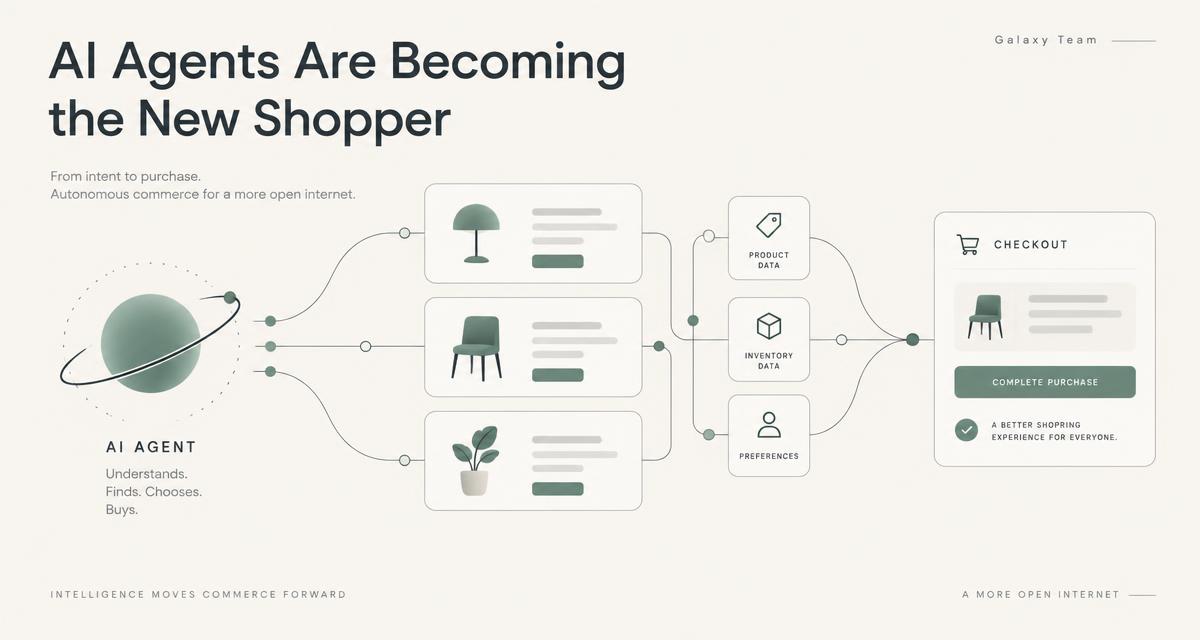
AI agents are changing how consumers discover, compare, and buy products. Learn how e-commerce brands can prepare their stores for the rise of agentic commerce.
For years, e-commerce has been built around a simple journey: Search → Website → Product Page → Cart → Checkout.
That journey is changing. Consumers are increasingly using AI systems to discover products, compare options, ask questions, and decide what is worth buying.
The next evolution is even bigger: AI agents are beginning to move beyond recommendations and toward taking actions on behalf of shoppers.
That means the future of e-commerce may not only be about getting a customer to visit your website. It may also be about making sure your products can be understood, evaluated, recommended, and ultimately purchased by the AI systems helping customers make decisions.
This is the rise of agentic commerce. For e-commerce brands, the opportunity is significant — but it requires thinking differently about product data, search, content, conversion, checkout, and the overall customer journey.
The Shopper Is Changing
The traditional online shopping journey usually starts with a customer actively searching for something. They type a query into Google, browse results, visit several websites, compare products, and eventually make a purchase.
AI introduces another layer. A shopper might now ask an AI assistant:
“Find me a lightweight running shoe for under $150 that works well for long-distance running.”
Instead of simply returning ten blue links, an AI system can help interpret the request, compare products, explain differences, and narrow down the options. The customer may never interact with every store that appears in the decision-making process.
This changes the role of product discovery. Your brand needs to be discoverable not only by people searching for products, but increasingly by the systems helping people decide which products deserve attention. We covered the foundations of this shift in our guide to AI shopping and product discovery.
What Is Agentic Commerce?
Agentic commerce describes an emerging model where AI agents can assist with — and increasingly act on — parts of the shopping and purchasing process.
Depending on the technology and permissions involved, AI agents can help shoppers:
- Discover products
- Compare products
- Understand product specifications
- Evaluate different options
- Find prices
- Check availability
- Make recommendations
- Initiate shopping actions
- Complete transactions
The important distinction is that AI is moving from being purely an information tool toward becoming part of the transaction journey.
Instead of asking “How do I get more people to my website?”, brands increasingly need to ask “Can the systems helping shoppers understand what we sell?” That is a very different question.
Your Product Data Is Becoming Part of Your Sales Team
One of the biggest implications of AI-driven shopping is the importance of accurate product information.
Human shoppers can often interpret incomplete information. AI systems need clear information to understand what a product actually is and whether it matches a specific request.
Important product information can include:
- Product name
- Product category
- Product attributes
- Size
- Materials
- Ingredients
- Compatibility
- Product specifications
- Pricing
- Variations
- Availability
- Shipping information
- Return policies
- Reviews
- Product benefits
Think about your product data as another layer of your sales infrastructure. If the information is incomplete, inconsistent, outdated, or difficult to interpret, your products may become harder for both shoppers and AI systems to evaluate.
Better product information does not replace good marketing. It gives good marketing something stronger to work with.
SEO Isn’t Disappearing — But It Isn’t the Whole Game
SEO remains important. But the way people discover information online is expanding.
A modern e-commerce discovery strategy increasingly needs to consider:
- SEO → Search engines
- AEO → Answer engines
- AI product discovery → AI assistants and shopping systems
- CRO → The experience that turns discovery into action
These areas overlap, but they are not identical. Traditional SEO focuses heavily on helping pages become visible in search results. AEO focuses on making information useful and understandable enough to appear in answers. AI product discovery adds another layer: making product information clear, structured, relevant, and useful for systems that may help shoppers compare products.
The goal isn’t to replace SEO. The goal is to make your brand easier to understand wherever customers — and the systems assisting them — are looking.
Your Product Page Has a New Job
A product page has traditionally been designed primarily for the human shopper. That remains essential.
But product pages increasingly need to communicate information clearly to multiple audiences: the customer, the search engine, the AI assistant, the shopping platform, and the product data system.
That means strong product pages should answer obvious questions clearly:
- What is the product?
- Who is it for?
- What problem does it solve?
- What makes it different?
- What are its specifications?
- How does it work?
- What does it cost?
- When can I receive it?
- What happens if I return it?
- What do other customers think?
The more clearly your product communicates these answers, the less interpretation the shopper — or the systems helping the shopper — has to perform. If your pages attract visits but stall at the decision, the friction is usually in the experience, not the traffic.
Checkout Is Becoming Part of the AI Commerce Conversation
Discovery is only one part of the equation. If AI systems increasingly help shoppers move from product discovery toward purchasing, payment and checkout infrastructure become increasingly important too.
Recent developments from major payment and commerce companies show that the industry is working toward systems that allow AI agents to act within defined purchasing permissions.
That could eventually mean shoppers giving an AI agent instructions such as “Find the best option under my budget” or “Buy this when it becomes available.”
The important issue for merchants is not simply automation. It is trust. Agentic commerce will depend on clear authorization, secure payments, merchant controls, accurate product information, and transparent customer experiences.
The brands that prepare for this shift will need to think about the entire journey — not just how their products appear in an AI answer.
What Shopify Brands Should Do Now
You do not need to completely rebuild your Shopify store because AI shopping is growing. Instead, start with the fundamentals.
- Clean up your product information. Make sure product titles, descriptions, specifications, variants, pricing, and availability are accurate.
- Make product attributes clear. Don’t force customers or systems to guess important product characteristics.
- Improve product descriptions. Write descriptions that answer real customer questions rather than simply filling a page with marketing language.
- Strengthen your FAQs. Answer the questions customers repeatedly ask before purchasing.
- Make policies easy to understand. Shipping, returns, delivery times, warranties, and other important information should be easy to find.
- Improve your reviews. Reviews provide useful social proof and additional context around real product experiences.
- Improve your structured product information. Make it easier for commerce platforms, search engines, and other systems to understand your products.
- Keep inventory information accurate. Outdated availability can create poor experiences for both shoppers and automated systems.
- Keep improving CRO. Getting discovered is only the beginning. If someone discovers your product through an AI assistant and lands on your store, the experience still needs to persuade them to buy.
What About Amazon, Faire, and Wix?
Agentic commerce isn’t only a Shopify conversation. Every commerce platform has the same fundamental challenge: can customers — and the systems helping customers — clearly understand what you sell?
For Amazon brands, this means paying close attention to listing quality, product attributes, images, reviews, pricing, availability, and other marketplace information.
For Faire brands, clear wholesale product information becomes especially important because retailers need to understand the product, brand, assortment, pricing, and potential fit for their stores.
For Wix brands, the same principles apply to product pages, structured information, content, search visibility, and conversion experience.
The technology may differ. The underlying principle doesn’t. Better commerce starts with better information.
The New E-commerce Growth Stack
The future of e-commerce will not be defined by one channel. It will be defined by how well the channels and systems work together.
- Discovery — SEO · AEO · AI discovery
- Product data — attributes · content · reviews · availability
- Experience — Shopify · Amazon · Faire · Wix
- Conversion — CRO · product pages · checkout
- Retention — email · personalization · lifecycle marketing
- Repeat purchase
The opportunity is not simply to appear in more places. It is to create a commerce system that remains understandable, discoverable, persuasive, and connected throughout the customer journey — right through to the second and third purchase.
The AI Commerce Readiness Checklist
Before worrying about the next wave of AI commerce technology, check your fundamentals.
- Is your product information accurate?
- Are your product attributes clearly defined?
- Are your product descriptions genuinely useful?
- Can shoppers quickly understand what makes each product different?
- Are your reviews visible and trustworthy?
- Are shipping and return policies easy to find?
- Is your inventory information accurate?
- Is your product information structured properly?
- Is your store mobile-friendly?
- Is your website fast?
- Does your product page answer the questions customers actually ask?
- Can someone who discovers your product through AI easily understand what to do next?
- Are you tracking where your traffic and conversions come from?
If several answers are no, there may be more opportunity in fixing the fundamentals than chasing the newest AI tool.
The Biggest Mistake Brands Can Make
The biggest mistake is treating AI commerce as another isolated marketing channel. It isn’t. At least, it shouldn’t be.
Adding another channel without improving the underlying commerce system simply creates another place where problems can appear.
A better approach is to strengthen the system underneath: better product data, better discovery, better product experiences, better conversion, better retention, better measurement. Then connect those pieces.
Because the goal isn’t simply to get recommended by an AI system. The goal is to be the brand that deserves the recommendation — and has the commerce infrastructure to turn that recommendation into a customer.
Where Galaxy Team Fits
Galaxy Team approaches e-commerce as a connected system rather than a collection of separate channels. That means looking at the entire journey: discovery, product experience, conversion, retention, and repeat purchase.
For brands operating across Shopify, Amazon, Faire, and Wix, the opportunity is to make those systems work together while improving the individual parts that influence growth. Our services can include:
- E-commerce strategy
- Shopify and Wix development
- Amazon marketplace optimization
- Faire optimization
- SEO
- AEO
- AI discovery readiness
- Product page optimization
- CRO
- Paid acquisition
- Email and lifecycle marketing
- Analytics
- AI and automation
AI may change how customers discover products. But the fundamentals of good commerce remain. Make the right product easy to discover. Make the information easy to understand. Make the experience easy to navigate. Make the purchase easy to complete. Then give customers a reason to return.
The Next Customer Might Not Search for Your Product
The next time someone needs a product, they may not begin with a traditional search engine. They may ask an AI assistant. And the system may decide which products are worth showing them.
That doesn’t mean traditional search, websites, or marketplaces are disappearing. It means another discovery layer is emerging.
For e-commerce brands, now is the time to make sure the foundation is ready. Because the future of shopping won’t only be about being found. It will be about being understood.
Commerce is becoming more connected. And the brands that prepare their systems now will be in a better position to participate in that evolution.
- AI Shopping
- Agentic Commerce
- E-commerce AI
- AI Product Discovery
- AI Search
- AEO
- E-commerce SEO
- Shopify
- CRO
- Product Data
- AI Agents