
General · Commerce
Black Friday Traffic Won't Fix a Store That Isn't Ready: The 2026 Q4 E-commerce Playbook
8 min read · 20 Sept 2026
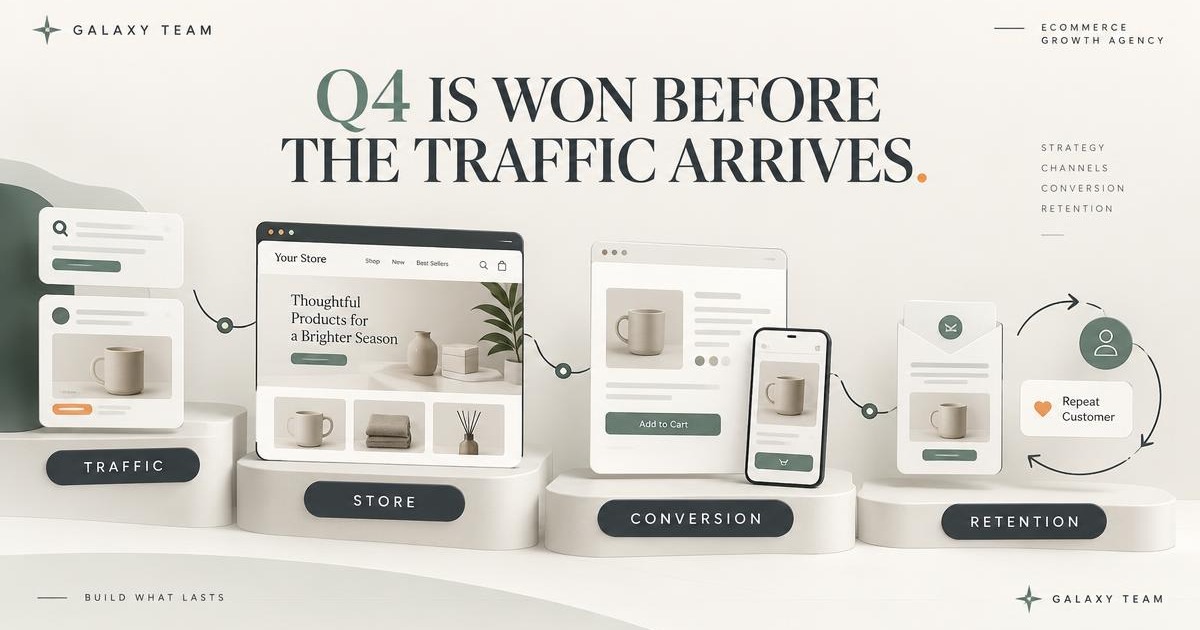
Black Friday can bring more shoppers to your store, but traffic alone cannot fix poor conversion. Learn how to prepare your e-commerce store for Q4 before the holiday rush arrives.
Black Friday can bring more people to your store.
It cannot make a confusing product page clearer.
It cannot make a slow website faster.
It cannot fix broken tracking.
It cannot create trust that wasn't there.
And it cannot turn first-time buyers into repeat customers if the retention system doesn't exist.
That's why the most important part of Q4 doesn't happen on Black Friday.
It happens before the traffic arrives.
The holiday shopping season is one of the most important periods of the year for many e-commerce brands across the United States and Europe.
But the brands that are prepared for the rush have something in common: they don't wait for the rush to begin before fixing the systems that have to handle it.
Your product pages need to be ready.
Your campaigns need to be ready.
Your website needs to be ready.
Your tracking needs to be ready.
Your retention systems need to be ready.
Because when demand increases, every weakness in the customer journey becomes easier to see.
Q4 isn't simply a traffic opportunity.
It's a stress test for your entire commerce system.
Why Q4 Preparation Starts Before Black Friday
Black Friday and Cyber Monday may be the most visible moments of the holiday shopping season, but they are not the only moments that matter.
Customers often research products before purchasing. They compare prices, read reviews, save products, revisit stores, ask questions, wait for promotions, subscribe to email lists and watch product videos.
That means the customer journey begins before the transaction.
If your brand waits until Black Friday to start preparing, you may be optimizing the busiest part of the season after the customer journey has already begun.
A better approach is to treat Q4 as a preparation cycle:
- Audit first.
- Improve second.
- Launch third.
- Optimize continuously.
The Q4 Shopper Is Not Just Looking for a Discount
Discounts are important during the holiday season, but price is not the only factor influencing a purchase.
Customers also want to know:
- Is this the right product?
- Can I trust this brand?
- Will it arrive on time?
- What happens if I need to return it?
- Is the product actually worth the price?
- What are other customers saying?
- Can I understand the product quickly?
- Is checkout going to be easy?
That means your Q4 strategy should not focus entirely on promotions.
The real opportunity is to make the entire buying experience easier.
A strong offer can attract attention. A strong commerce experience helps turn that attention into a purchase.
More Holiday Traffic Won't Fix a Weak Store
One of the easiest mistakes to make in Q4 is assuming that more traffic automatically means more revenue.
It doesn't.
If a product page is confusing, more visitors simply create more opportunities for shoppers to leave. If your checkout is difficult, additional traffic does not solve the problem. If your mobile experience is poor, increasing ad spend can amplify the problem. If your product information is unclear, customers still have unanswered questions.
Before increasing your holiday advertising budget, examine what happens after the click. Look at:
- Product page engagement
- Add-to-cart behavior
- Conversion rate
- Checkout completion
- Mobile experience
- Site speed
- Reviews
- Trust signals
- Shipping information
- Return information
Traffic is important. But traffic × conversion is what creates the opportunity for growth. Our guide to Shopify conversion optimization explores this relationship in more detail.
Audit Your Product Pages Before Increasing Ad Spend
Your product page is where acquisition meets conversion.
A customer may arrive from Google, Meta, TikTok, Amazon, email, organic search, an influencer or an AI shopping assistant.
But once they reach your product page, the page has to do the work.
Before Q4 traffic increases, ask:
- What is this product?
- Who is it for?
- Why should I care?
- What makes it different?
- How does it work?
- What does it cost?
- When will it arrive?
- Can I return it?
- Can I trust the brand?
- What are other customers saying?
A strong product page should answer these questions without making the customer search for the information.
Q4 is not the time to discover that your best-selling product page has been missing critical information for six months.
Prepare Your Google and Meta Campaigns Before Competition Intensifies
Holiday advertising can become more competitive because more brands are competing for the same shoppers. That makes preparation important.
Before increasing spend, make sure your campaigns have:
- Clear audience targeting
- Strong creative
- Relevant landing pages
- Accurate conversion tracking
- Clear offers
- Strong product-market alignment
- A mobile-friendly destination
- A plan for retargeting
Don't treat your ad account and website as separate systems.
The ad makes the promise. The landing page has to deliver on it.
If your advertisement says one thing and your product page communicates something completely different, friction appears.
Your Q4 campaigns should feel like one connected customer journey. Galaxy Team's e-commerce services are structured around that connected system rather than isolated channels.
Get Your Amazon Listings Q4-Ready
For brands selling on Amazon, Q4 preparation extends beyond advertising.
Your listing is part of your conversion system. Review:
- Main image
- Product title
- Product features
- Product description
- A+ Content
- Reviews
- Pricing
- Variations
- Inventory
- Search intent
- PPC targeting
Amazon PPC can increase visibility. But visibility does not guarantee conversion.
The same principle applies: Traffic → Listing → Conversion.
If the listing is not ready, increasing the budget may simply increase the number of shoppers who reach a product page that still needs work.
Q4 preparation should therefore include both marketplace advertising and marketplace conversion optimization.
Make Your Shopify Store Ready for Mobile Shoppers
A significant portion of e-commerce activity happens on mobile devices. That makes mobile experience particularly important during high-traffic periods.
Check:
- Navigation
- Product images
- Product descriptions
- Sticky add-to-cart behavior
- Search
- Filters
- Cart experience
- Checkout
- Page speed
- Pop-ups
- Tap targets
- Form fields
Don't simply resize your desktop website and call it a mobile strategy.
Walk through the entire purchase journey on an actual phone. Open the homepage. Find a product. Read the description. Select a variant. Add it to cart. Start checkout.
Ask yourself: Where could a customer hesitate? Where could they get confused? Where could they leave?
Those friction points are opportunities to improve before Q4 traffic arrives.
Fix Site Speed and Checkout Friction
The holiday season is not the time to discover that your website contains unnecessary friction.
Every additional step creates another opportunity for a customer to leave.
Review:
- Page loading
- Image sizes
- App scripts
- Pop-ups
- Checkout fields
- Shipping surprises
- Payment options
- Error messages
- Mobile usability
The goal isn't to remove everything. The goal is to remove what doesn't help the customer make a decision.
A faster, clearer and more predictable shopping experience gives your marketing a stronger foundation.
Build Your Black Friday and Cyber Monday Landing Pages Early
Don't wait until the promotion begins to build the page customers are supposed to land on.
Prepare your key landing experiences in advance. Think about:
- Black Friday collections
- Cyber Monday collections
- Gift guides
- Seasonal bundles
- Best sellers
- Product categories
- Holiday landing pages
- Promotional banners
- Email landing pages
- Paid advertising destinations
Each page should have one clear purpose.
Don't make customers navigate through five menus to find the promotion they clicked on.
If the ad says “Holiday Gift Collection,” the landing page should immediately make that collection clear. Consistency reduces friction.
Make Sure Your Tracking and Attribution Actually Work
Q4 is one of the worst times to discover that your tracking is incomplete.
You need to understand what is happening across your customer journey. Check:
- Analytics
- Conversion tracking
- Google Ads tracking
- Meta Pixel
- Server-side tracking where appropriate
- UTM parameters
- Shopify analytics
- Amazon reporting
- Email attribution
- Conversion events
The exact technology will depend on your stack.
The principle is simple: if you cannot measure what is happening, you cannot confidently decide what to improve.
Q4 should not become a period of guessing.
Prepare Your Email and Lifecycle Systems
The customer journey doesn't end when someone buys.
In fact, Q4 can create a large opportunity to build relationships with new customers.
Before the holiday rush, review your:
- Welcome flows
- Browse abandonment
- Cart abandonment
- Post-purchase flows
- Product education
- Review requests
- Cross-sell flows
- Win-back campaigns
Don't send the same message to everyone.
A new subscriber has different needs from a first-time customer. A first-time buyer has different needs from a repeat customer. A customer who hasn't purchased in months needs a different message again.
Your Q4 acquisition strategy should connect with your retention strategy.
Don't Let Your Black Friday Customers Disappear After November
One of the biggest opportunities in Q4 is what happens after the holiday season.
Someone who purchases from you during Black Friday is not automatically a one-time customer.
The post-purchase experience matters. Consider:
- Helpful product education
- Delivery communication
- Review requests
- Cross-sell opportunities
- Personalized recommendations
- Loyalty incentives
- Relevant follow-up campaigns
The goal isn't to force another purchase immediately.
The goal is to create a reason for the customer to remember the brand and return when the next relevant need appears.
This is where acquisition and e-commerce retention become connected.
Your Q4 Commerce System Should Look Like This
DISCOVERY
Google · Meta · TikTok · SEO · Email · AI Discovery
↓
PRODUCT EXPERIENCE
Product Pages · Reviews · Content · Trust
↓
CONVERSION
Cart · Checkout · Payment
↓
RETENTION
Email · Lifecycle · Personalization
↓
REPEAT PURCHASE
Loyalty · Cross-sell · Customer Experience
The objective is not to optimize one isolated channel.
The objective is to make the entire journey work together across your commerce platforms.
The 30-Day Q4 Readiness Checklist
Week 1 — Audit
- □ Review your highest-traffic pages
- □ Review your highest-revenue products
- □ Check mobile UX
- □ Review site speed
- □ Audit product pages
- □ Review checkout friction
- □ Check tracking
Week 2 — Fix
- □ Improve weak product pages
- □ Fix broken or confusing navigation
- □ Improve trust elements
- □ Clarify shipping and returns
- □ Improve mobile experience
- □ Fix tracking issues
Week 3 — Build
- □ Prepare holiday landing pages
- □ Prepare promotional campaigns
- □ Build email flows
- □ Prepare creative assets
- □ Prepare retargeting audiences
- □ Review Amazon listings
Week 4 — Test
- □ Test the purchase journey
- □ Test mobile checkout
- □ Test campaign tracking
- □ Test landing pages
- □ Review product availability
- □ Review customer support processes
- □ Identify remaining friction
Then continue monitoring and optimizing throughout Q4.
The Biggest Q4 Mistake: Waiting for the Rush
The biggest mistake isn't necessarily having the wrong campaign.
It's waiting too long to fix the system underneath the campaign.
Q4 gives brands an opportunity to generate more attention and more customers. But it also exposes weaknesses.
A slow website becomes more noticeable. A confusing product page loses more potential customers. Poor tracking creates more uncertainty. Weak retention leaves more acquired customers behind.
That's why Q4 preparation should not be treated as a marketing task.
It should be treated as a commerce-system project.
Where Galaxy Team Fits
Galaxy Team helps brands connect the parts of e-commerce that are often managed separately.
Shopify. Amazon. Faire. Wix. Paid acquisition. SEO. Conversion optimization. Email and lifecycle marketing. Analytics. AI and automation.
The goal isn't simply to generate more traffic.
It's to make the journey from discovery to purchase to repeat purchase work better.
For Q4, that means looking at the entire system: traffic, product experience, conversion, retention, measurement and optimization.
Because when the traffic arrives, your store should already be ready for it.
Q4 Is Won Before the Traffic Arrives
Black Friday traffic can create opportunity. But opportunity still needs a system capable of converting it.
Your campaigns can attract the shopper.
Your product page has to convince them.
Your checkout has to make purchasing easy.
Your fulfillment experience has to deliver on the promise.
And your retention system has to give them a reason to come back.
That's why the smartest Q4 preparation isn't simply: “How do we get more traffic?”
It's: “Is our entire commerce system ready for the traffic we're about to create?”
Start there. Then scale.
Is Your Store Ready for Q4?
Before increasing your holiday traffic, let's identify the friction, conversion gaps and growth opportunities inside your commerce system.
- Q4 Ecommerce
- Holiday Ecommerce
- Black Friday
- Cyber Monday
- Ecommerce Strategy
- Shopify
- Amazon
- CRO
- Holiday Shopping
- Ecommerce Marketing
- Q4 Strategy
- Conversion Rate Optimization