

Faire · Commerce
Faire Wholesale Trends 2026: What Retailers Are Searching For — and How Brands Can Get Discovered
8 min read · 23 Sept 2026
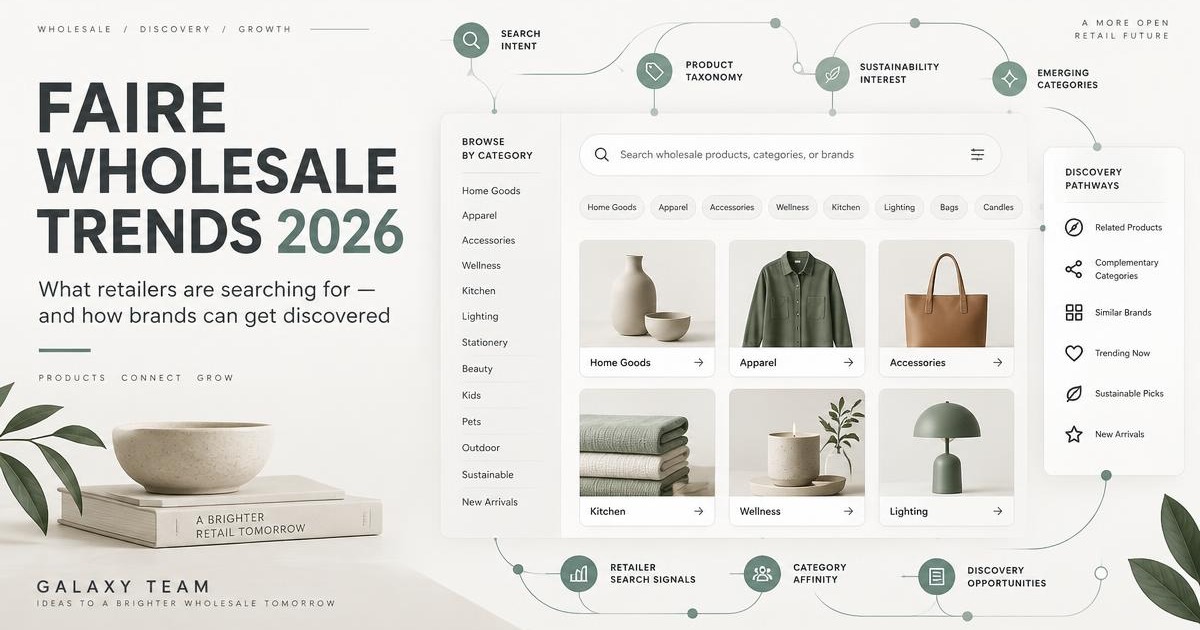
Discover the latest Faire wholesale trends for 2026, what retailers are searching for, and how brands can optimize their Faire storefront to get discovered.
Wholesale buying is changing quickly.
Retailers are no longer relying only on traditional trade shows, sales representatives, catalogs, and word of mouth to discover new products. Marketplaces such as Faire give retailers another way to discover brands, research products, and place wholesale orders.
That creates an important opportunity for brands: being listed on Faire is not the same as being discoverable on Faire.
Your products need to appear when retailers are searching, make sense when they land on the product page, and give buyers enough information and confidence to take the next step. Faire’s marketplace reporting also illustrates how quickly retailer demand can move across categories and seasons.
So what are retailers searching for right now? And what can brands do to make sure their products are positioned for discovery? Let’s look at the latest verified signals and what they mean for Faire brands.
What Is Happening on Faire Right Now?
Faire’s 2026 trend reporting shows how consumer culture, seasonal moments, retailer interest, and wholesale purchasing can influence one another.
In its Spring 2026 apparel report, Faire says it pairs cultural observations with proprietary marketplace search and catalog data. Its Holiday 2026 wholesale buying guide similarly notes that retailers research and buy well before peak seasonal demand.
A simplified pattern looks like this:
A trend appears in culture → retailers notice it → related searches grow → well-positioned products have an opportunity to be discovered.
This does not mean every cultural signal becomes durable demand. It means brands should understand how their existing products align with the language, categories, and use cases retailers are exploring.
The Faire Products Retailers Are Searching For in 2026
Verified Faire reports show that search interest can change quickly and vary sharply by category.
- Faire reported a 512% increase in searches for trench coats between July and November in its Spring 2026 apparel report.
- The same report said catalog uploads for trench coats increased 53% in the final quarter measured.
- Faire reported that searches for “back to school” increased 175% year over year in 2025, with demand peaking in July, in its 2026 back-to-school trend report.
- Its 2026 summer food report said searches for guava rose 50% from March to April and coconut searches increased 143% year over year.
These are Faire-reported marketplace signals for specific periods and categories. They do not represent the entire wholesale market, and they should not be treated as universal forecasts.
Sources: Faire, “The Spring 2026 apparel report”, January 21, 2026; Faire, “Back-to-school trends for 2026 every retailer should know”, May 22, 2026; Faire, “Your summer 2026 wholesale food trends”, May 8, 2026.
Why Faire Trends Can Change So Quickly
Retail buying is increasingly connected to what consumers see and discuss elsewhere.
Social content → consumer interest → retailer awareness → Faire search → product discovery → wholesale order → product reaches consumers
The opportunity is not to chase every trend. It is to recognize relevant demand early and ensure the brand is positioned clearly when retailers begin searching. That requires better product data, purposeful merchandising, and an understanding of the customer and retailer contexts around the product.
Local Trends Are Becoming Wholesale Opportunities
Demand is not always uniform across regions, cities, or store types. Faire’s 2026 Independent Retail Report emphasizes the role independent retailers play in curating products for their communities and the importance of local taste.
For brands, this creates an important question: are you trying to appeal to everyone, or are you identifying the retailers, store types, and markets where your products have the strongest fit?
The next wholesale opportunity may begin with a particular customer community, merchandising theme, or regional need rather than a single national trend.
What This Means for Faire Brands
Trends alone do not generate wholesale orders. Retailers still need to discover the product, understand it, evaluate the opportunity, and decide whether it fits their business.
That makes your Faire storefront part of the sales process. A retailer should be able to quickly understand:
- What the product is and who it is for
- Why customers may want it
- What makes it different
- How it fits their assortment
- What the wholesale and suggested retail pricing look like
- Whether the brand feels credible
- What makes the supplier worth exploring
If those answers are difficult to find, the retailer has to work harder. Unnecessary friction can make product discovery less effective.
How to Optimize Your Faire Storefront for Product Discovery
1. Make Your Product Titles Searchable
Creative product names can support branding, but retailers also need to understand exactly what the product is. Where appropriate, titles should communicate the product type, key characteristics, and useful descriptors. The goal is to make each product easier to understand and easier to discover.
2. Write Product Descriptions Around Retailer Intent
A strong wholesale description should do more than describe an item. It should explain who the end customer is, which need it addresses, what makes it different, where it fits in an assortment, and what the buyer needs to know before ordering.
Faire’s official SEO checklist for brands is a useful reference for improving discovery without treating optimization as keyword stuffing.
3. Complete Your Product Attributes
Product information should be complete and accurate. Relevant attributes help retailers understand what they are viewing and can support discovery. Strong photography cannot compensate for missing specifications or unclear options.
4. Improve Product Photography
Use clear, high-quality images that show the product, important details, scale where useful, packaging where relevant, necessary angles, and context when it helps a buyer evaluate the item. Photography should reduce uncertainty rather than simply decorate the page.
5. Make the Wholesale Economics Easy to Understand
Make wholesale price, suggested retail price, minimum order quantity, case quantities, variations, and relevant fulfillment information easy to find. Do not make retailers hunt for basic purchasing details.
6. Build Logical Collections
Organize the Shop page around categories, product types, use cases, or seasonal opportunities that make sense from a buyer’s perspective. A retailer should be able to move through the catalog without feeling lost.
7. Optimize for Seasonal Demand
If a product is relevant to an upcoming buying period, prepare the collection, imagery, product information, and merchandising before retailers begin placing orders. Our 2026 Q4 e-commerce playbook explains why the wider commerce system should be ready before traffic and demand arrive.
Faire Holiday Trends Matter Too
Faire’s verified 2026 holiday guide says retailer research and sourcing begin well before the final quarter. The report noted that holiday searches increased between April and May, reinforcing the need to prepare seasonal assortments early.
Its guidance covers Halloween, Thanksgiving, and Christmas buying windows and encourages retailers to leave time to compare brands, test products, receive inventory, and build displays before peak demand.
For brands, the practical lesson is timing: seasonal products should be described, photographed, grouped, and stocked before buyers start building those assortments.
Source: Faire, “Your Holiday 2026 wholesale buying guide”, August 4, 2026.
What Faire Brands Should Be Doing Before Q4
If your brand depends on wholesale orders, waiting until the holiday rush arrives is too late. Review product titles, descriptions, attributes, photography, collections, pricing, minimum order quantities, inventory, seasonal products, retailer messaging, and Shop page presentation.
The objective is not to make your Faire store look busy. It is to make the buying journey easier. That principle also connects to building repeat revenue after the first purchase: clear expectations and a strong experience support the next order, not only the first.
Faire Is Expanding Beyond Traditional Retail Buyers
In June 2026, Faire announced that it was opening its marketplace to business-use buyers purchasing products for their own operations rather than resale.
Faire specifically identified restaurants, hotels, corporate buyers, and event companies. Depending on the product category, those audiences can create new use cases for suitable brands.
This creates another reason to think carefully about positioning. The question is no longer only, “Would a retailer stock this?” It can also be, “Which supported types of businesses could use this product?”
Source: Faire, “Faire Opens Its Wholesale Platform to Millions of Business-Use Buyers”, June 18, 2026.
Faire SEO: Getting Found Is Only the First Step
Search visibility matters, but visibility alone is not enough.
Discovery → product page → product understanding → buyer confidence → wholesale order → repeat order
A retailer can find your product and still decide not to buy it. Faire optimization should connect product discovery, product presentation, retailer confidence, commercial information, and conversion. This is where SEO and conversion-focused product experience start working together.
The same principle is becoming important beyond marketplace search. As explained in our guide to AI shopping and product discovery, structured, accurate product information helps both people and emerging discovery systems understand what a product is.
The Faire Optimization Checklist
- ☐ Product titles clearly explain what each product is
- ☐ Product descriptions answer retailer questions
- ☐ Product attributes are complete
- ☐ Product images are clear and professional
- ☐ Collections are easy to navigate
- ☐ Wholesale pricing is easy to understand
- ☐ Suggested retail pricing is clear where appropriate
- ☐ Minimum order information is clear
- ☐ Seasonal products are properly organized
- ☐ The Shop page communicates the brand clearly
- ☐ The assortment makes sense for target retailers
- ☐ The storefront gives buyers enough information to make a decision
The Biggest Mistake Faire Brands Make
One of the biggest mistakes is treating the Faire storefront like a catalog rather than a commerce experience. Uploading products is only the beginning.
A useful wholesale storefront helps buyers move from “What’s this?” to “Could this sell?” to “Does this fit my store?” to “I understand the opportunity” and, finally, “I’m ready to order.”
Every unclear image, missing detail, or confusing product structure creates another point of friction.
Where Galaxy Team Fits
At Galaxy Team, we look at Faire as part of a broader commerce system. We examine the full buyer journey: discovery → product presentation → retailer confidence → conversion → repeat wholesale business.
Our e-commerce growth services can support Faire storefront and listing optimization, wholesale merchandising, product-page CRO, collection organization, search discovery, retailer-focused experience, conversion strategy, and the wider commerce system.
The objective is simple: make it easier for the right retailers to discover your products, understand your offer, and take the next step.
The Faire Opportunity Is Bigger Than Being Listed
Faire gives brands a way to reach independent retailers and eligible business buyers. But being present on a marketplace does not automatically make a brand discoverable.
Brands that pay attention to retailer intent, product presentation, search visibility, and the buying experience create more opportunities to turn discovery into useful wholesale relationships.
The question is not simply, “Are we on Faire?” It is: “Can the right buyer find us, understand us, and confidently place an order?”
Is Your Faire Store Ready for the Next Wave of Wholesale Demand?
Galaxy Team helps brands improve their Faire storefront, product discovery, conversion experience, and broader e-commerce growth system.
Explore Our Faire Capabilities →
Sources
- Faire — The Spring 2026 apparel report, January 21, 2026.
- Faire — Back-to-school trends for 2026 every retailer should know, May 22, 2026.
- Faire — Your summer 2026 wholesale food trends, May 8, 2026.
- Faire — Your Holiday 2026 wholesale buying guide, August 4, 2026.
- Faire — SEO checklist for Faire brands, September 9, 2025.
- Faire — Faire Opens Its Wholesale Platform to Millions of Business-Use Buyers, June 18, 2026.
- Faire — Independent Retail Report, July 22, 2026.
- Faire Wholesale
- Faire Trends 2026
- Faire SEO
- Wholesale Trends
- Faire Brands
- Faire Retailers
- Wholesale Marketing
- Faire Storefront Optimization
- Faire Product Optimization
- E-commerce Growth
- Wholesale E-commerce
- Conversion Rate Optimization