

Wix · Commerce
Wix eCommerce in 2026: How to Build a Store That Converts and Gets Found by AI
8 min read · 9 Oct 2026
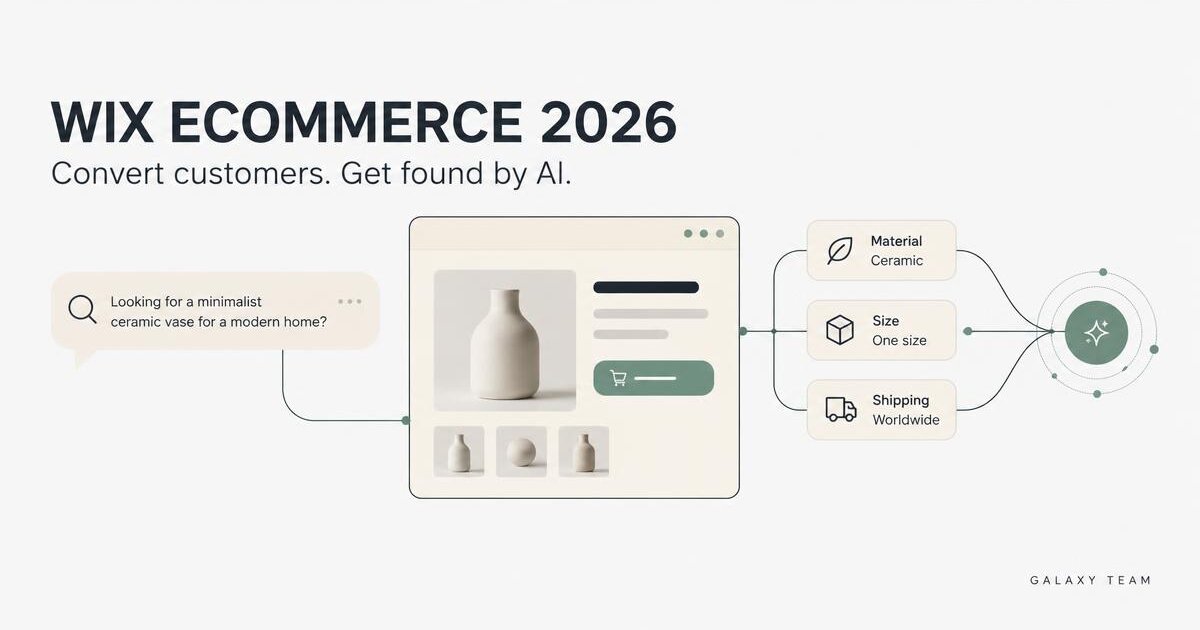
Wix eCommerce is changing quickly. Learn how to build a store that creates a better customer experience, converts visitors, and is prepared for AI-powered product discovery.
Wix eCommerce has moved far beyond simply putting products on a website.
Today, an online store has to do several jobs at once.
It needs to help people discover products.
It needs to explain why those products are worth buying.
It needs to create trust.
It needs to make checkout simple.
And increasingly, it needs to make its products understandable to AI systems that are helping people search, compare and shop.
That changes the question businesses should be asking.
Instead of:
"How do I build a Wix store?"
The better question is:
"How do I build a Wix commerce system that people can understand, trust and buy from — while also being ready for the way discovery is changing?"
In 2026, that means thinking about three connected areas:
Conversion.
Search visibility.
AI discovery.
And they should not be treated as separate projects.
1. A Wix Store Is More Than a Website
Your storefront is only one part of the customer journey.
A customer might discover your product through Google.
They might see your brand on social media.
They might ask an AI assistant for product recommendations.
They might visit your product page several times before purchasing.
They might leave without buying and return through an email campaign.
Every one of those interactions influences the final purchase.
That's why good eCommerce optimization isn't simply about making a website look better.
It's about making the entire journey work better.
A strong Wix store should help customers move naturally through (much like the journey we cover in why a Shopify store can get traffic but not convert):
Discovery → Product → Trust → Conversion → Retention
If one stage creates friction, improving another stage won't necessarily solve the problem.
2. Conversion Still Comes Before More Traffic
It's easy to assume that an eCommerce business needs more visitors.
Sometimes it does.
But more traffic doesn't automatically solve a conversion problem.
Imagine sending thousands of additional visitors to a product page that doesn't clearly explain:
- What the product is
- Who it's for
- Why it is different
- How much it costs
- How delivery works
- What happens if the customer changes their mind
- Why the customer should trust the business
The traffic has arrived.
The buying experience hasn't improved.
Before increasing acquisition spend, review the experience those visitors receive.
Look at:
Homepage
→ Is the value proposition immediately clear?
Navigation
→ Can customers find the right products quickly?
Product page
→ Does it answer the questions customers have before buying?
Cart
→ Are costs and next steps clear?
Checkout
→ Is the process straightforward?
Post-purchase
→ Does the relationship continue after the sale?
Conversion optimization should be connected to the entire customer journey.
3. AI Is Changing How People Discover Products
Search is becoming more conversational.
Instead of typing a short keyword into a search engine, people can increasingly describe what they want in natural language and ask AI systems to research options.
For example:
"Find me a lightweight waterproof jacket for hiking in cold weather."
Or:
"Show me skincare products suitable for sensitive skin without fragrance."
The AI system needs to understand the products before it can recommend them.
That means product information matters more than ever. We explore this shift further in AI Agents Are Becoming the New Shopper.
Your store needs to communicate:
- Product type
- Features
- Materials
- Sizes
- Colors
- Use cases
- Compatibility
- Availability
- Pricing
- Shipping
- Returns
- Brand information
The more complete and structured the information is, the easier it becomes for systems — both human and machine — to understand what you're selling.
Wix is increasingly building infrastructure around AI discovery and agentic commerce, including structured data, AI visibility features and integrations designed to help eligible merchants participate in AI-powered shopping experiences.
Availability of specific Wix AI commerce capabilities can vary by merchant, region and rollout stage, so not every Wix store will have access to every feature at the same time.
4. Your Product Data Matters More Than Ever
Great product photography is important.
Good copy is important.
But product information also needs to be clear and structured.
Think beyond marketing language.
Instead of:
"Experience the ultimate premium performance."
Give customers — and discovery systems — useful information.
For example:
Material: 100% organic cotton
Fit: Relaxed
Available sizes: XS–XXL
Color: Sand
Use: Everyday casual wear
Care: Machine washable
Shipping: Ships within 2 business days
The point isn't to write for robots.
The point is to make your products easier to understand.
Clear information helps people make decisions.
It can also give AI systems better information to work with when evaluating products.
5. AI Visibility Is Not the Same as Traditional SEO
SEO and AI visibility overlap, but they aren't identical.
Traditional SEO focuses heavily on helping pages appear in search results.
AI visibility is increasingly about whether your business and products can be understood, referenced and surfaced within AI-generated answers and shopping experiences.
That means businesses should think about:
SEO
→ Can search engines understand and rank the page?
Content
→ Does the page genuinely answer the customer's question?
Structured data
→ Is important product information clearly represented?
Entity and brand clarity
→ Is it obvious who the business is and what it sells?
Product information
→ Are important attributes complete and consistent?
AI readability
→ Can AI systems understand the page and product information?
You don't need to abandon SEO.
You need to build a commerce presence that works across multiple discovery surfaces — the same principle behind Amazon seller strategy in 2026 and Faire wholesale discovery.
6. Wix Is Bringing AI Into the Store Management Layer
AI isn't only changing how customers discover products.
It's also changing how merchants manage their businesses.
Wix currently provides a growing set of AI-powered capabilities across areas such as:
- Site management
- Analytics
- Marketing
- SEO
- Customer communication
- Product recommendations
- Product descriptions
- Meta tags
- Email creation
- Product imagery
- Automation
Wix has also introduced specialized AI agents for different business functions.
These include tools for site management, marketing, customer engagement and automation.
The important point isn't that every business should turn on every AI feature.
It is:
Use AI where it removes repetitive work or improves the customer experience.
Technology should simplify the system.
It shouldn't create another layer of complexity.
7. Personalization Can Make the Shopping Experience More Relevant
Not every visitor arrives with the same intent.
One person may be discovering your brand for the first time.
Another may already know exactly which product they want.
Another may have purchased before.
A useful eCommerce experience should recognize that customers can have different needs.
AI-powered personalization can help stores surface relevant products, recommendations and experiences based on shopper behavior.
But personalization should support the customer journey.
It shouldn't become another source of distraction.
The objective isn't:
"Show the customer more things."
The objective is:
"Help the customer find the right thing faster."
8. Your Product Page Still Has to Convert the Human
Even if AI helps someone discover your product, the human buying decision still matters.
Your product page needs to create confidence.
Ask:
Is the product immediately understandable?
Are the images useful?
Does the copy explain the benefits?
Are important specifications easy to find?
Are reviews visible?
Are shipping and returns clear?
Is the price easy to understand?
Is the CTA obvious?
A technically optimized product feed won't compensate for a confusing product page.
AI discovery may create the opportunity.
Your commerce experience still has to earn the purchase.
9. Mobile Conversion Should Be Treated as a Priority
A large percentage of eCommerce journeys happen on mobile devices.
That means your Wix store needs to be designed around the smaller screen rather than simply adapted to it.
Check:
- Navigation
- Product image sizing
- Font readability
- CTA placement
- Variant selection
- Product information
- Cart interactions
- Checkout
- Popups
- Page speed
Ask someone unfamiliar with your website to complete a purchase using their phone.
Don't help them.
Watch what they struggle with.
Every hesitation is useful information.
10. Don't Add More Features Before Fixing the Journey
This is where many eCommerce stores go wrong.
A problem appears.
The business adds an app.
Another problem appears.
Another tool gets installed.
Soon the website has:
- Multiple popups
- Multiple analytics tools
- Multiple marketing integrations
- Multiple recommendation systems
- Multiple scripts
- Multiple forms
But the customer journey is still confusing.
The goal isn't to build the most complicated Wix store.
It's to build the most effective system for the business.
Before adding another tool, ask:
What problem are we solving?
How will we measure whether it worked?
Does the customer actually need it?
Could we solve the problem more simply?
Better systems don't always require more technology.
Sometimes they require less.
11. Build for Both Human Shoppers and AI Discovery
The best approach isn't creating one website for people and another for AI.
It's creating a website that is clear to both.
That means:
For people:
Clear messaging.
Useful product information.
Strong visuals.
Trust signals.
Simple navigation.
Easy checkout.
For search engines:
Relevant content.
Logical page structure.
Descriptive metadata.
Technical SEO.
Structured product information.
For AI discovery:
Complete product attributes.
Clear factual information.
Consistent brand information.
Readable content.
Structured data.
Accurate availability, shipping and policy information where applicable.
The overlap is important.
What makes your store easier for an AI system to understand often also makes it easier for a customer to understand.
12. What Should a Wix Store Owner Optimize First?
Don't try to fix everything simultaneously.
Start with the areas closest to revenue.
Step 1 — Audit the customer journey
Go from landing page to purchase.
Look for friction.
Step 2 — Review your product pages
Check whether customers have enough information to make a decision.
Step 3 — Check mobile
Test your highest-value pages on an actual phone.
Step 4 — Improve product information
Make your titles, descriptions and product attributes clear and specific.
Step 5 — Review SEO
Look at page titles, descriptions, headings, internal linking and product content.
Step 6 — Review AI readiness
Check whether your important business and product information is clear, structured and accessible.
Step 7 — Review your analytics
Identify where customers are entering, engaging, dropping off and converting.
Step 8 — Test before scaling
Make improvements based on evidence rather than assumptions.
The Wix Growth Checklist
Before spending more money on traffic, ask:
Can visitors understand what we sell immediately?
Can customers find the right product quickly?
Does every important product page answer the customer's questions?
Is our product information complete and accurate?
Does the mobile experience feel effortless?
Are shipping and returns clear?
Are our trust signals visible?
Is our checkout simple?
Can search engines understand our pages?
Can emerging AI shopping systems understand our products?
Are we using AI where it genuinely saves time or improves the experience?
Are we measuring what happens after someone clicks?
If several answers are "no," adding more traffic may not be the first thing to fix.
Where Galaxy Team Fits
At Galaxy Team, we don't look at a Wix store as just a website.
We look at it as part of a connected commerce system.
That means combining:
Commerce Strategy
Wix Development
Conversion Rate Optimization
SEO & AI Visibility
Paid Acquisition
Product Experience
Email & Retention
Analytics & Optimization
The objective isn't to add more activity.
It's to identify where the customer journey is breaking, fix the highest-impact problems, and build systems that can improve over time.
Because growth isn't just about getting more people to your website.
It's about what happens after they arrive.
The Future of Wix eCommerce Is Connected
The next generation of eCommerce won't be defined only by how attractive a storefront looks.
It will be defined by how well the entire commerce system works.
Customers will continue to discover products through search, social media, marketplaces and increasingly AI-powered experiences.
AI will continue to change how merchants create content, analyze data, communicate with customers and manage operations.
But one principle remains:
Make it easier for the right customer to find, understand, trust and buy your product.
Build for humans.
Structure your information clearly.
Use technology where it creates real value.
And keep optimizing the journey.
Your Wix store doesn't need to do everything.
It needs to do the important things exceptionally well.
Sources
Explore how we work across platforms in our Wix and platform capabilities.
- Wix
- Wix eCommerce
- Wix eCommerce 2026
- Wix SEO
- Wix CRO
- Wix AI
- Agentic Commerce
- AI Product Discovery
- AI Shopping Agents
- E-commerce Growth
- Conversion Rate Optimization